In the world of martial arts, practical self-defense skills are highly valued, and Judo offers effective, real-world techniques that can boost confidence and personal safety. Known as “the gentle way,” Judo emphasizes leverage, timing, and controlled use of an opponent’s force, making it a valuable martial art for self-defense, regardless of size or strength. Judo’s focus on throws, joint locks, pins, and balance disruption translates well to real-life scenarios, empowering practitioners to handle challenging situations with skill and control.
One of Judo’s most practical techniques for self-defense is learning how to break falls, or “ukemi.” In Judo, practitioners learn how to absorb the impact of a fall, distribute force across the body, and rise quickly. Ukemi isn’t just for the dojo; knowing how to fall safely can reduce the risk of injury in everyday accidents, like tripping or slipping. For those interested in self-defense, mastering ukemi is foundational, providing confidence that, if thrown or pushed, they can protect themselves from harm. This confidence in falling often translates into an enhanced sense of balance and stability, which is useful in many physical activities and daily movements.
Throws are another powerful aspect of Judo that can be effective in real-life situations. Techniques such as osoto-gari (major outer reap) or ippon seoi nage (one-arm shoulder throw) allow practitioners to unbalance and throw an opponent using leverage rather than strength. These throws can be invaluable in self-defense situations where disengaging from a confrontation is the primary goal. In Judo, throws are designed to end a confrontation quickly by using minimal force while maintaining maximum control. For example, if an attacker grabs your clothing or attempts to hold you in place, a well-executed throw can redirect their force, sending them to the ground while giving you a chance to safely exit the situation.
In addition to throws, Judo includes various joint locks, particularly arm locks, or kansetsu waza. Arm locks are useful in scenarios where control is needed without causing significant injury. For instance, an arm lock can immobilize an aggressor long enough to de-escalate a situation or wait for assistance. Techniques such as ude-hishigi-juji-gatame (cross arm lock) enable practitioners to restrain an attacker effectively. These techniques are designed with control in mind, aiming to minimize harm while ensuring safety. By manipulating an opponent’s joints, Judo practitioners can use leverage to neutralize threats without relying on brute force, making it especially useful for individuals of all sizes.
Judo also trains practitioners to develop spatial awareness and balance, which are vital skills in real-world self-defense. By learning to sense changes in weight distribution and pressure, practitioners can anticipate moves and respond before an opponent gains control. This heightened awareness allows Judokas to detect shifts in an aggressor’s movements, improving their ability to evade or counter attacks effectively. Balance disruption is a core principle in Judo, where every technique aims to unbalance the opponent. In self-defense, this means that even a simple shift in weight can neutralize a threat, enabling the practitioner to redirect an attacker’s force rather than resisting it.
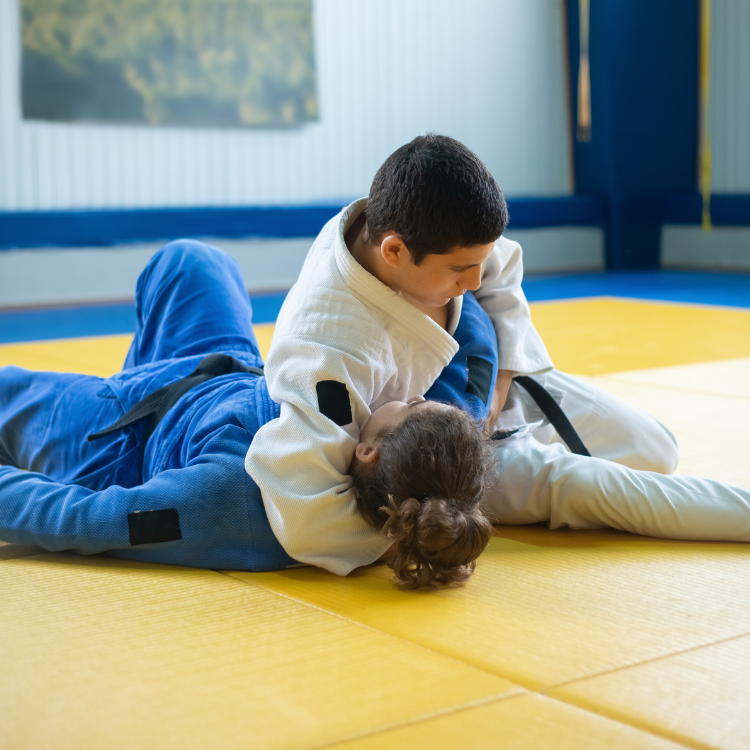
Pins, or osaekomi waza, also have practical applications outside the dojo. Pins allow a practitioner to control an opponent by holding them in a fixed position. Techniques such as kesa-gatame (scarf hold) and yoko-shiho-gatame (side four-corner hold) are designed to maintain control without causing harm, which is beneficial in situations where restraint, rather than escalation, is necessary. For example, if a Judoka encounters an aggressive person, these holds can help keep the individual in place long enough for the situation to be managed safely.
What makes Judo particularly suited to real-world situations is its focus on timing, control, and efficiency. Rather than relying on brute force, Judo teaches practitioners to read an opponent’s intentions and respond with precision and timing. This mindset promotes a calm, strategic approach to potentially dangerous situations, making it effective for self-defense. Training in Judo fosters self-discipline and respect, which encourages practitioners to prioritize de-escalation and safety whenever possible.
In summary, Judo’s practical techniques for self-defense focus on control, leverage, and timing, providing a non-aggressive way to handle confrontations. By learning breakfalls, throws, joint locks, and pins, practitioners gain skills that are valuable for real-world scenarios, helping them protect themselves while minimizing harm to others. This focus on controlled responses and awareness is what makes Judo an empowering martial art, equipping people of all backgrounds with the tools to navigate both physical and mental challenges confidently.